
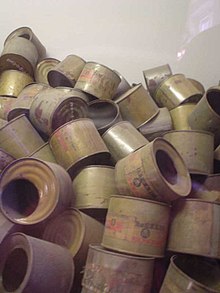
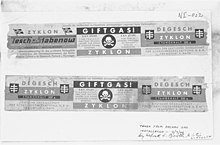
Zyklon B awalnya dikembangkan pada tahun 1920-an sebagaiinsektisida oleh Walter Heerdt , Bruno Tesch dan Gerhard Peters, diInstitut Kaiser Wilhelm untuk Kimia Fisika dan Elektrochemistry diBerlin-Dahlem, yang direkturnya pada saat itu adalah Dr Fritz Haber, dunia-terkenal kimia dan tahun 1918 penerima Penghargaan Nobel dalam Kimia untuk penemuan metode untuk sintesis organik dariamonia.
Pada awal 1942, Zyklon B telah dipilih oleh Rezim Nazi sebagai alat pemusnahan pilihan baik untuk Auschwitz-Birkenau dan Majdanekkamp pemusnahanselama Holocaust. Kimia merenggut nyawa sekitar 1,2 juta orang di kamp-kamp ini.
Degesch memainkan peran kunci dalam pembuatan Zyklon B dalam Perang Dunia II. Banyak perusahaan-perusahaan Jerman saham di Degesch, tetapi semua pada akhirnya menjual sahamnya kepada raksasa kimia Degussa (sekarang dikenal sebagai Evonik) pada awal 1920-an. Degussa mengembangkan proses untuk memproduksi Zyklon B dalam "kristal" (sebenarnya silika gel penyerap potongan), seperti yang digunakan selama Perang Dunia II. Untuk meningkatkan modal, Degussa membagi kepentingan yang mengendalikan Degesch denganIG Farben pada tahun 1930: kedua perusahaan memegang 42,5% saham di Degesch, dengan sisa 15% dipegang oleh Th. Goldschmidt AG dari Essen .
Peran Degesch saat ini terbatas pada perolehan hak paten dankekayaan intelektual: hal itu tidak dengan sendirinya memproduksi Zyklon B. Zyklon B pembuatan ditangani oleh Dessauer Werke für Chemische Zucker dan Werke, yang memperoleh keseimbangan dari IG Farben, agen peringatan dari ScheringAG dan asam prussic dari Dessauer Schlempe dan berkumpul mereka ke produk akhir. Perusahaan ini diekstrak prussic asam dari produk-produk limbah daribit gula proses pemurnian. Dari tahun 1943 sampai 1945,Kaliwerke, dari kota Ceko Kolin, juga diberikan asam prussic ke Werke Dessauer.
Setelah produksi, Zyklon B dijual oleh Degesch untuk Degussa. Untuk memangkas biaya, Degussa menjual hak pemasaran Zyklon B ke dua perantara: para Heerdt dan Linger GmbH (Eli) dan Tesch dan Stabenow (Tesch und Stabenow, Gesellschaft für Internationale Schädlingsbekämpfung mbH, atau Testa) dariHamburg. Keduanya pemasok membagi wilayah mereka sepanjang Elbe sungai, dengan Heli menangani klien di barat dan Testa melakukan hal yang sama di sebelah timur.
Zyklon B masih di produksi di Republik Ceko di pabrik Draslovka Kolín seperti di kota Kolín di bawah tradename Uragan D2, dijual untuk memberantas serangga dan binatang kecil.

From 1929 and onwards in the U.S. Zyklon B used to disinfect the carriage of goods and clothing from the Mexican immigrants entering the United Serikat.Farm Securities Administration photographer Marion Post Wolcott noted the use of Zyklon B cyanide gas and by Public Health Service in New Orleans Quarantine Station during the 1930s .
Used By Nazis
Zyklon B used by Nazi Germany to poison prisoners in their networks chamber extermination camps throughout Europe. Zyklon B used at Auschwitz Birkenau, Majdanek, one of Sachsenhausendan Operation Reinhard camps. In the extermination camps other, carbon monoxide from the exhaust of engines used in mobile gas chambers or gas vans. Most of the victims were Jews and the Zyklon B gas to the central symbol of the Holocaust.
Zyklon B used in concentration camps initially for delousing to control typhus. Chemical used in gas chambers was deliberately made without the warning odorant.
In January or February 1940, 250 Gypsy children from Brno in the Buchenwald concentration camp used as guinea pigs to test the Zyklon B gas. On September 3, 1941, some 600 Soviet prisoners of war and 250 sick Polish prisoners gassed with Zyklon B at Auschwitz camp I; this is the first experiment with the gas at Auschwitz. Experiments lasted more than 20 hours.
According to Rudolf Hoss, commandant of Auschwitz, bunker 1 held 800 people, and bunker 2 held 1,200. Once the room is full, the doors closed and dense mess of Zyklon B pellets dropped into the room through vents in the side wall, releasing cyanide gas. They are the die within 20 minutes, the death rate depends on how close the prisoners stood to vent the gas, according to Hoss, who estimated that about one third of the victims died instantly. Johann Kremer, an SS doctor who oversaw the gassings, testified that: "Shouting and screaming of the victims could be heard through the opening and clear that they were fighting for their lives." When they are removed, if the room was very crowded, because often, the victims were found half-squatting, their skin pink with red spots and green, some foaming at the mouth or bleeding from the ears.
The legacy of World War 2
After the war, two directors Testa - Bruno Tesch and Karl Weinbacher - tried by the British military court and sentenced to death for their role in supplying chemicals.
The use of the word Zyklon (German for cyclone) continues to prompt angry reactions from Jewish groups. In 2002, the Bosch Siemens Hausgeräte and Umbro were forced to withdraw from the attempt to use or trademark the term for their products.
The Holocaust deniers say that the Zyklon B gas was not used in the gas chamber, relying on as evidence at a low level of Prussian blue residue in the sample chamber was found by Fred A. Leuchter, Leuchter is regarded as a general delousing of buildings. Leuchter's negative control, gasket material samples taken from other buildings in the camp, registered as not having the rest of cyanide. The manager of the analytical laboratory hired by Leuchter states in an interview in Errol Morris' film Mr. Death: The Rise and Fall of Fred A. Leuchter, Jr., that Leuchter is thick samples of brick would be very mixed cyanide residue, which only formed a very fine layer on the wall and could not penetrate.
In 1994, the Institute of Forensic Research in Kraków reviewed this claim on the grounds that the formation of Prussian blue by exposure of bricks to cyanide is not the most likely reaction. Microdiffusion using more sophisticated techniques, they tested 22 samples from the gas chambers, delousing room (as a positive control), and shelter (as a negative control), find the delousing cyanide residue in both the space and the ruins of the gas chambers but none in the ruins of the stay.
Source: wikipedia


Tidak ada komentar:
Posting Komentar